The Pink Panther Strikes Again Dvd the Return of the Pink Panther 1975 Poster
| The Return of the Pinkish Panther | |
|---|---|
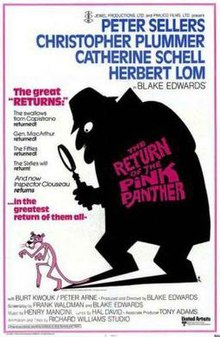 Theatrical release poster | |
| Directed by | Blake Edwards |
| Written by | Blake Edwards Frank Waldman |
| Produced past | Blake Edwards Animation: Richard Williams Ken Harris |
| Starring | Peter Sellers Christopher Plummer Catherine Schell Herbert Lom |
| Cinematography | Geoffrey Unsworth |
| Edited by | Tom Priestly |
| Music past | Henry Mancini |
| Production | ITC Entertainment |
| Distributed past | United Artists |
| Release date |
|
| Running time | 114 minutes |
| Countries | United Kingdom U.s. |
| Linguistic communication | English |
| Budget | $v 1000000 |
| Box role | $75 million[ane] |
The Return of the Pinkish Panther is a 1975 comedy motion picture and the fourth film in The Pink Panther serial. The film stars Peter Sellers, returning to the role of Inspector Clouseau, for the first time since A Shot in the Dark (1964), later having declined to reprise the function in Inspector Clouseau (1968). The moving-picture show was a commercial hit and revived the previously dormant series and with it Peter Sellers' career.
Herbert Lom reprises his role as Chief Inspector Charles Dreyfus from A Shot in the Dark; he remained a regular thereafter. The graphic symbol of Sir Charles Litton, the notorious Phantom, is now played past Christopher Plummer rather than David Niven, who played the part in The Pinkish Panther (1963) and was unavailable. The Pink Panther diamond over again plays a key role in the plot.
Plot [edit]
In the fictional state of Lugash, a mysterious thief seizes the Pinkish Panther diamond and leaves a white glove embroidered with a gold "P". With its national treasure one time once again missing, the Shah of Lugash requests the assistance of Inspector Clouseau (Peter Sellers) of the Sûreté, as Clouseau had recovered the diamond the concluding time it was stolen (in The Pinkish Panther). Clouseau has been temporarily demoted to beat cop by his boss, Chief Inspector Charles Dreyfus (Herbert Lom), who despises him to the point of obsession, simply the French government forces Dreyfus to reinstate him. Clouseau joyously receives the news and duly departs for Lugash, but not before fending off a surprise attack from his servant Cato (Burt Kwouk), who had been ordered to do and so to go along the Inspector on his toes.
Upon examining the offense scene in the national museum — in which, due to his habitual clumsiness, he wrecks several priceless antiques — Clouseau concludes that the glove implicates Sir Charles Litton (Christopher Plummer), allonym "the notorious Phantom," equally the thief. Afterwards several catastrophic failures to stake out Litton Manor in Nice, Clouseau believes a mysterious assassin is attempting to impale him. He follows Sir Charles' wife, Lady Claudine Litton (Catherine Schell), to the Gstaad Palace hotel in Switzerland in search of clues to her husband'due south whereabouts, and repeatedly bungles the investigation.
Meanwhile, Sir Charles is teased about the theft by his wife, and realizes he has been framed. Arriving in Lugash to clear his name, Sir Charles barely avoids beingness murdered and sent to the Lugash undercover police by his associate known as the "Fat Man" (Eric Pohlmann), who explains that with the leading suspect dead, the secret police will no longer have an excuse to go on purging their political enemies. Escaping to his suite, Litton finds secret police Colonel Sharki (Peter Arne) waiting for him, who implies the Fat Man's understanding is correct, merely reminds him the diamond must be recovered eventually. Sir Charles pretends to cooperate, only is unable to hide his reaction when he recognizes a face on the museum'southward security footage. He avoids some other plot past the Fat Man and his duplicitous underling Pepi (Graham Stark) and escapes from Lugash, secretly pursued by Sharki, who believes Sir Charles will lead him to the diamond.
In Gstaad, Clouseau, still tailing Lady Claudine, is all of a sudden ordered by Dreyfus over the phone to arrest her in her hotel room. However, when Clouseau calls back to clarify the lodge, he is told that Dreyfus is on vacation. Sir Charles, who in the meantime has chartered a private flight out of Lugash, arrives at the hotel and is kickoff to confront his wife. Lady Claudine admits she stole the jewel to spark excitement in their lives. Colonel Sharki shows up, but just as he prepares to kill them both, Inspector Clouseau barges in. Sir Charles explains things to Clouseau, and Sharki is near to kill the three of them. Nevertheless, Dreyfus has followed Clouseau and is outside the hotel room with a rifle — Dreyfus is in fact the "mysterious assassin" who has been trying to kill Clouseau all this time — and merely every bit Dreyfus shoots at Clouseau, the Inspector ducks to check if his fly is undone, and the shot kills Sharki instead. The other three take comprehend, while Dreyfus, insanely enraged by his latest failure to impale Clouseau, goes berserk until he is arrested.
For once once again recovering the Pink Panther, Clouseau is promoted to Master Inspector, while Sir Charles resumes his career equally a jewel thief. At a Japanese eating place in the epilogue, Cato unexpectedly attacks Clouseau again and triggers a massive brawl, destroying the premises. Dreyfus is committed to a lunatic asylum for his deportment, where he is straitjacketed inside a padded prison cell and vows revenge on Clouseau. The motion-picture show ends when the Pink Panther (in cartoon class) enters Dreyfus' jail cell and films him writing "The End" on the wall.
Bandage [edit]
- Peter Sellers as Inspector Jacques Clouseau
- Christopher Plummer equally Sir Charles Litton
- Catherine Schell as Lady Claudine Litton
- Herbert Lom as Primary Inspector Charles Dreyfus
- Burt Kwouk equally Cato Fong
- Peter Arne as Colonel Sharki
- Peter Jeffrey as General Wadafi
- Grégoire Aslan as Primary of Lugash Law
- David Lodge as Mac
- Graham Stark as Pepi
- Eric Pohlmann as The Fat Man
- André Maranne as François
- Victor Spinetti as Hotel Concierge
- John Bluthal equally Blind Ragamuffin
- Mike Grady equally Bell Male child
- Peter Jones as Psychiatrist
Production [edit]
In the early on 1970s, Blake Edwards wrote a 15-20 page outline for another Pinkish Panther film and presented it to series producer Walter Mirisch. The producer loved the idea, but the franchise's benefactor and main backer, United Artists, rejected the film as they had no interest in working with Edwards nor Peter Sellers, whose careers had declined.[two]
British producer Lew Course agreed to finance two films for Blake Edwards as part of a deal to get Edwards' wife, Julie Andrews, to appear in a Television special for him. The first movie was The Tamarind Seed. Edwards wanted to brand a project ready in Canada chosen Rachel and the Stranger, simply Grade disliked the idea and offered to buy Edwards out of the second commitment. Edwards wanted to brand a second film, however; in order to help restore his tainted reputation in Hollywood. Class said he and then suggested making a new Pinkish Panther motion picture and Edwards agreed, if Sellers would as well agree to do it. Grade managed to talk Sellers into it and the project was on.[3] UA agreed to give The Return of the Pink Panther to Grade in exchange for world distribution and a share of the profits;[2] thereafter, Grade's company would permanently ain worldwide rights to the film.[4] Grade said that Eric Pleskow of United Artists was offered the chance to come into the movie as a partner only declined, thinking the picture would be a fiscal failure; he merely wanted UA to distribute.[three]
Richard Williams, later the blitheness director on Who Framed Roger Rabbit, did the blithe open and closing titles for this movie and The Pink Panther Strikes Over again, due to DePatie–Freleng's work on the Pinkish Panther shorts and other drawing projects for TV and motion-picture show. Williams got help animating this from two noted animators, Ken Harris and Fine art Babbitt.
Carol Cleveland, best known for her regular appearances on Monty Python's Flying Circus, has a small part equally a swimming pool diver.
A soundtrack album, featuring Henry Mancini's score for the film, was released by RCA Records.[v] A novelization, written by the film's co-author, Frank Waldman, was belatedly published by Ballantine Books in March 1977 (ISBN 0345251237).[ citation needed ]
Reception [edit]
Disquisitional reception [edit]
In The New York Times, Vincent Canby gave the flick a positive review, writing, "Clouseau is the very special slapstick triumph of Mr. Sellers and Mr. Edwards."[6] Diverseness called it "another very funny picture about the eternal gumshoe bungler, Inspector Clouseau. 'The Return of the Pink Panther' is in many ways a fourth dimension capsule motion-picture show, total of brilliant sight gags and comedic innocence."[7] Cistron Siskel of the Chicago Tribune gave the moving-picture show two stars out of 4, finding Sellers' first scene funny only for the balance of the flick, "we not but know when each and every joke is coming; we know exactly what that joke volition exist."[8] Charles Champlin of the Los Angeles Times wrote that the film was "I call back, not upwards to what went before. Its calculations show and the inspector is somehow too entirely the buffoon, lacking a redeeming pathos I seem to remember from the before outings. But in its vigorous and bulls-eye fashion 'The Return of the Pinkish Panther' is a cheerful escape from all the things that ail the states."[9] Gary Arnold of The Washington Mail called information technology "a ofttimes hilarious and by and large satisfying return to comic course on the part of Peter Sellers, recreating the role of the hapless but dogged French sleuth."[ten] Penelope Gilliatt of The New Yorker wrote that Sellers was "working here at his best."[11]
The moving picture holds a score of 84% on Rotten Tomatoes based on 19 reviews, with an average rating of half dozen.7 out of 10.[12]
Box part [edit]
The picture show grossed $41.8 million in the United States and Canada and $75 million worldwide.[thirteen] [1]
Home media release [edit]
The movie had been released on VHS, Betamax, CED and Laserdisc in the 1980s by Magnetic Video, CBS/Fox Video, and J2 Communications respectively.
In 1993 and 1996, Live Home Video under the Family Home Entertainment label re-released the film on VHS as part of the Family Abode Entertainment Theater lineup and on a Widescreen Laserdisc. In 1999, Artisan Entertainment (Alive's successor) re-released the film on VHS and debuting on DVD for the first fourth dimension in the original widescreen format. The only bonus cloth seen on this release were cast filmographies, production notes and the film's original theatrical trailer.
In 2006, rights holder Granada (owners of the ITC catalog) sub licensed the film to Universal Studios Home Entertainment nether Focus Features for distribution in the US and United kingdom, with a new, blank-basic release featuring an anamorphic widescreen transfer being released in 2006 by Universal in both territories. In 2015, the 2006 Great britain DVD was reissued by Fabulous Films yet under licence from Universal and ITV Studios (who acquired Granada and the ITC library), followed by a Uk Blu-ray release by Fabulous in 2016.
As Metro-Goldwyn-Mayer has since acquired United states of america theatrical rights, along with worldwide television and digital distribution rights,[xiv] Universal/Focus and ITV still take all remaining worldwide rights for the film. Due to its licensing output deals with both MGM and Universal, Shout! Mill included this film, along with the other Peter Sellers Pink Panther films, as part of a half dozen-disc set up for the first time on Blu-ray under their Shout! Select label.[fifteen] The set was released on June 27, 2017, thus making it the first Pinkish Panther film collection to include the picture show.[16]
References [edit]
- ^ a b "The Pink Panther Strikes Again (advert)". Multifariousness. 22 December 1976. p. 9.
- ^ a b Mirisch, Walter (2008). I Thought We Were Making Movies, Not History (pp. 170-171). University of Wisconsin Press, Madison, Wisconsin. ISBN 0-299-22640-9.
- ^ a b Lew Class, Still Dancing: My Story, William Collins & Sons 1987 p 227-228
- ^ Ltd, Not Panicking. "h2g2 - 'The Return of the Pink Panther' - the Moving picture - Edited Entry". world wide web.h2g2.com.
- ^ "Henry Mancini – Blake Edwards' the Render of the Pink Panther (1975, Vinyl)". Discogs.
- ^ Canby, Vincent (22 May 1975). "Distraction Stalks Inspector Clouseau". The New York Times: 32.
- ^ "The Return of the Pink Panther". Diverseness: 26. 14 May 1975.
- ^ Siskel, Gene (June 16, 1975). "That familiar, zany inspector overstays visit". Chicago Tribune. Section 3, p. 6.
- ^ Champlin, Charles (May 20, 1975). "Sellers Back in 'Panther'". Los Angeles Times. Part Four, p. 1.
- ^ Arnold, Gary (21 May 1975). "Welcome 'Return of The Pinkish Panther'". The Washington Post: B1.
- ^ Gilliatt, Penelope (2 June 1975). "The Current Cinema". The New Yorker. p. 92.
- ^ "The Return of the Pink Panther". Rotten Tomatoes . Retrieved 18 March 2022.
- ^ "The Return of the Pinkish Panther, Box Office Information". Box Office Mojo. Retrieved 22 Jan 2012.
- ^ "Official KINO Insider Announcements Thread: STRICTLY Moderated: READ GUIDELINES".
- ^ "Blake Edwards' 'The Pink Panther Film Collection' Blu-ray Announced". highdefdigest.com. 6 January 2017.
- ^ "The Pink Panther Motion picture Drove Blu-ray".
External links [edit]
- The Return of the Pink Panther at IMDb
- The Return of the Pink Panther at the TCM Flick Database
- The Return of the Pink Panther at AllMovie
- The Return of the Pink Panther at the American Motion-picture show Plant Catalog
Source: https://en.wikipedia.org/wiki/The_Return_of_the_Pink_Panther
0 Response to "The Pink Panther Strikes Again Dvd the Return of the Pink Panther 1975 Poster"
Post a Comment